What a returned COD parcel really costs you
A refused COD parcel earns nothing and still costs two courier charges and the ad spend that won the order. Here is the sum per parcel and per month, and how to put the goods back on your books.
Alevate Books · 20 Oct 2026 · 3 min read
A returned cash-on-delivery parcel — an RTO, return to origin — earns nothing. It still costs the courier charge to send it, the charge to bring it back, and the ad spend that won the order. In the example below, each return costs about Rs 688, and 300 returns in a month cost Rs 99,000 in courier charges alone.
The cost of one return
Take the example month from our guide on real profit for a COD store: 1,200 orders booked, Rs 4,30,000 spent on ads, a courier charge of Rs 180 a parcel and Rs 150 to bring a parcel back.
| What a returned parcel cost | Rs |
|---|---|
| Courier charge to send it | 180 |
| Courier charge to bring it back | 150 |
| Ad spend per order booked (Rs 4,30,000 ÷ 1,200) | 358 |
| Total | 688 |
The goods come back to the shelf, so they are not lost. Everything else is.
The cost across a month
With 300 of the 1,200 parcels returned, the courier charges on returns alone come to 300 × Rs 330 = Rs 99,000. The ad spend that won those 300 orders is another Rs 1,07,500 that brought in nothing.
That is why the delivery rate moves profit so hard. In this example, every extra 1% of parcels delivered adds about Rs 23,000 to the month, and below 65.1% delivered, the month makes a loss. You can try your own figures in the free COD profit calculator.
Put the goods back on your books
When a parcel comes back, two things have to happen in the books, together:
- The sale is reversed. The order was recorded as a sale when it was sent; it is not one any more.
- The goods go back into stock at the cost they left at — not at the selling price.
If only the first happens, your stock count and your books disagree. If neither happens, the month shows a sale that never paid.
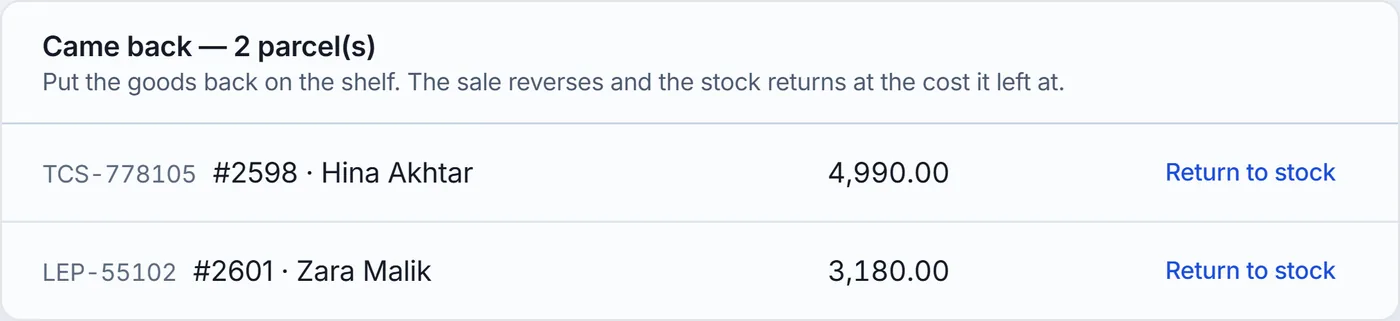
In Alevate Books, a parcel that came back is one click by someone on your team: Return to stock reverses the sale and puts the goods back at their cost.
Keep returns on their own line
Fold return charges into "courier charges" and the cost of returns disappears into the cost of delivery. Keep them apart and you can see, month by month, whether returns are getting better or worse.

Frequently asked questions
Is a COD return the same as a refund?
No. With a refund the customer paid and you pay them back. With a COD return the customer refused the parcel, so no money changed hands — but you still paid the courier both ways.
Are returned goods a loss?
The goods themselves are not, as long as they go back into stock at cost and can be sold again. The loss is the courier charges and the ad spend.
What lowers returns?
Most brands start with confirming orders before dispatch — a WhatsApp message or a call — and checking addresses. Measure your delivery rate before and after any change, so you know what worked.
Where should return charges go in the books?
On their own expense line, separate from delivery charges, so you can see what returns cost each month.